Timber-inspired visual displays deliver an organic warmth noticeably distinct from standard industrial acrylics, cold metals, or moulded plastic panels. The natural character of wood grain introduces genuine individuality, whilst contemporary workshop fabrication—such as precision laser scoring and additive 3D manufacturing using wood-fibre filaments—enables companies to showcase sharp, professional branding that retains handcrafted charm.
Selecting the ideal timber-style display requires weighing functional demands alongside visual appeal. You should examine the installation setting, whether the piece sits indoors or in a sheltered exterior location, viewing distances, text volume, and the structural format best suited to the premises.
This guide assesses recessed, multi-colour inlaid, and freestanding timber-style displays across coffee houses, retail boutiques, grooming salons, eateries, workspaces, and commercial premises. At KianoStyle, our Weston-super-Mare workshop crafts custom timber-effect displays combining wood-fill filament 3D printing and workshop laser craft.
If you already have a clear direction in mind, browse our [wooden signs collection](/wooden-signs/) to discover our bespoke fabrication styles.
Why Choose Wooden Signage for a Business?
Wood features an organic texture that gives brand presentations an approachable, artisanal feel compared to standard synthetic sign materials.
It proves especially effective across diverse commercial environments:
- Coffee houses and dining venues
- Barbershops and styling salons
- Independent retail boutiques
- Boutique guest accommodation and pubs
- Artisan studios and maker brands
- Corporate offices and front desks
- Creative production spaces
- Pop-up events and trade showcases
What Types of Wooden Signs Are Available?
Commercial buyers generally focus on three practical fabrication avenues:
- Recessed or laser-scored timber signs
- Multi-colour inlaid or surface-bonded signs
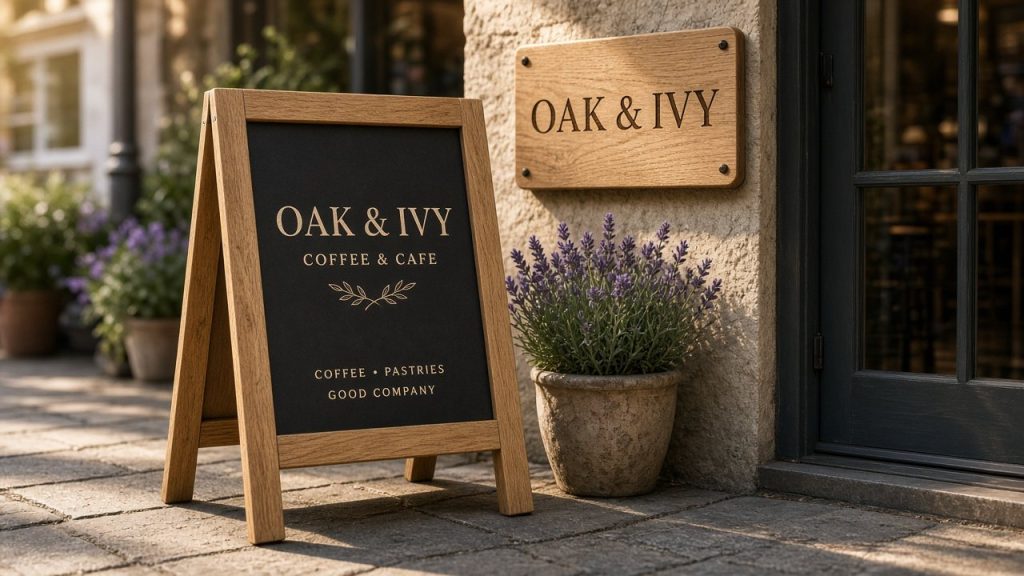
- Freestanding pavement A-frame displays
Engraved Wooden Signs
Traditional laser scoring vapourises a tiny depth of natural plywood to trace lettering, insignias, or clean line graphics. In additive manufacturing, our studio produces an honest equivalent with our [3D printed wood-effect engraved sign](/product/3d-printed-wood-effect-engraved-sign/), forming a wood-fill PLA panel containing genuine timber fibres with the emblem recessed in a contrasting darker filament inlay.
This approach achieves crisp perimeter boundaries and delicate detailing, allowing the tactile organic texture to command visual interest across the finished installation.
Recessed profiling is exceptionally well suited to:
- Company trading names
- Emblems featuring distinct perimeters
- Internal suite designations
- Wayfinding and directional indicators
- Doorway and reception plaques
- Concise operational statements
- Subtle, understated brand marks
Printed Wooden Signs
Across the wider sign industry, flatbed UV printing is frequently used to apply inks onto timber faces when complex colour reproduction is needed. At KianoStyle, rather than relying on ink that may chip or scratch, we manufacture our [wood-effect 3D printed sign](/product/wood-effect-3d-printed-sign/) by 3D printing in wood-fill PLA and building the logo from separate solid-colour filament parts, either inlaid flat or raised in 3D. The colour runs right through each printed component rather than sitting as paint on the surface.
This manufacturing method reliably reproduces:
- Multi-tone corporate emblems
- Bespoke vector illustrations
- Service pricing lists
- Key marketing announcements
- Scannable digital QR codes
- Layered brand graphics
Wooden A-Board Signs
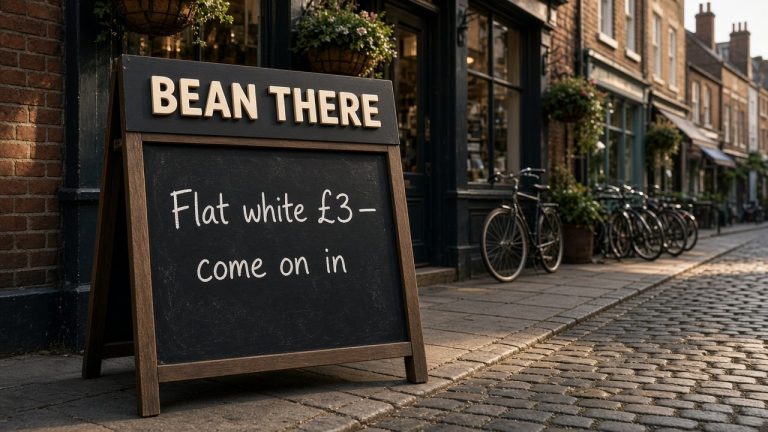
A pavement sandwich board acts as a moveable standalone panel that staff can relocate to catch maximum pedestrian footfall.
Businesses rely on pavement boards for several everyday requirements:
- Primary business emblems
- Daily food menus and specials
- Trading operating times
- Rotating promotional highlights
- Seasonal discount notices
- Directional pedestrian cues
- Gathering or event schedules
- Quick smartphone links
Engraved or Printed: Which Is Better?
Neither methodology holds an absolute advantage. The superior pick depends entirely on your specific graphics and brand personality.
Recessed and engraved signs offer a natural, tactile appearance with wood grain remaining visually prominent, making them excellent for lettering, simple logos, and classic handcrafted brand character with strong lines. Conversely, multi-colour 3D printed or inlaid signs provide full-colour branding with greater chromatic flexibility, making them far better suited to complex graphics, detailed artwork, and contemporary versatile branding.
If your emblem hinges predominantly on typography and concise line work, recessed scoring delivers timeless sophistication.
Where authentic colour matching or intricate graphic components are mandatory, multi-colour raised or inlaid additive construction provides significantly greater scope.
What Wood Works Well for Signage?
Varied timber types and engineered boards demonstrate distinct grain patterns, hues, weights, and face textures.
In our Somerset studio, we utilize premium birch plywood for genuine laser engraving alongside wood-fill PLA (a composite filament packed with real wood fibres) for additive builds, ensuring a consistent surface finish with authentic organic texture.
You may encounter varied terminology across trade suppliers. Irrespective of phrasing, the chosen substrate must match your visual detail and display location.
Coarse, knotty timber might complement a rugged farmhouse theme, but it disrupts delicate lettering. A uniform surface guarantees crisp edge fidelity on intricate emblems and smaller text.
How Should You Design Wooden Signage?
Effective wooden design begins with uncompromised visual clarity.
Although the tactile timber backdrop looks inviting, the installation must convey its intended message in a fraction of a second.
Keep a clear visual hierarchy
Viewers ought to digest essential elements in logical order:
- Primary trading title or mark
- Core takeaway message
- Subsidiary details or opening times
Choose a readable font
Typography must mirror your business character whilst maintaining effortless legibility from across the room.
Ornate script styles can complement tea rooms, botanical boutiques, or grooming salons, whereas clean geometric grotesque fonts perform brilliantly within corporate and retail environments.
Our comprehensive [installation and design guides](/how-to-install-a-3d-wall-sign/) discuss how font spacing, tone separation, and line-of-sight influence reading ease.
Use sufficient contrast
Because timber features organic striations and warm undertones, the background already possesses inherent visual activity.
Recessed marks benefit from distinct tonal differentiation against the surrounding face, while multi-colour components must pop clearly over the wood tones.
Artwork that appears vivid against a pristine white computer monitor frequently requires tonal tuning prior to workshop fabrication.
Choosing the Right Size and Placement
Overall dimensions should derive directly from the mounting location and how passers-by will observe the piece.
Key planning considerations include:
- Line-of-sight viewing distance
- Available mounting surface area
- Installation eye-level height
- Total word count and detail
- Typical pedestrian walking pace
- Surrounding furniture or displays
- Primary objective: branding versus navigation
Wooden Signage for Shops, Cafés and Restaurants
Timber-effect displays blend seamlessly into settings where natural textures and warm materials form core elements of the interior architecture.
Within retail shops, timber pieces commonly serve as:
- Wall-mounted corporate badges
- Operational trading times
- Till counter point-of-sale displays
- Department directional wayfinding
- In-store promotional markers
Wooden Signage for Offices and Reception Areas
Timber displays need never appear rustic or unrefined.
Sharp recessed detailing, tidy typography, and disciplined layouts yield sophisticated corporate displays appropriate for:
- Welcome reception lobbies
- Commercial executive suites
- Creative design agencies
- Boardrooms and meeting spaces
- Internal circulation directions
- Doorway facility markers
Indoor and Outdoor Use
In interior environments, wooden boards stay shielded from moisture and UV degradation, proving exceptionally dependable across offices, retail floors, and dining spaces.
Exterior installations demand far greater technical caution.
Driving rain, thermal swings, damp air, and intense solar exposure gradually degrade untreated timber. Weatherproof performance calls for suitable filaments, sealed timbers, or specialised engineering matched to the location.
A plaque tucked beneath an overhanging shopfront canopy meets vastly gentler conditions than a board subjected to direct downpours and open weather.
For these reasons, exterior durability should always be evaluated according to the specific product composition—such as weather-hardy PETG—rather than presuming every wooden board can withstand British winters.
Sustainable Signage and Durability
While timber enjoys an eco-conscious reputation as an organic raw material, authentic sustainability involves the entire production lifecycle.
Relevant considerations encompass:
- Responsible material harvesting
- Low-waste additive manufacturing
- Expected operational lifespan
- Routine cleaning routines
- Surface protection sealants
- Local logistics and delivery
How Can Wooden Signs Be Mounted?
Selecting an appropriate mounting technique depends upon overall weight, structural dimensions, surface material, and final height.
Standard mounting approaches include:
- Traditional wall screws
- Concealed rear bracket fixings
- Suspended ceiling wire systems
- Heavy-duty mechanical fixings
- Dimensional standoff spacer barrels
- High-bond double-sided foam adhesives
Which Wooden Sign Is Right for Your Business?
Follow these straightforward guidelines to pinpoint your ideal specification:
Opt for a recessed or laser-scored timber sign if you prefer an understated, tactile finish where your emblem relies on clean typographic silhouettes.
Opt for a multi-colour 3D printed timber-effect sign if your artwork demands exact brand colours, raised tactile layers, or detailed vector graphics.
Opt for a freestanding A-frame board if you need a moveable promotional display for a high street shopfront, salon entrance, restaurant terrace, or trade fair.
You can browse and configure these choices directly across our [custom wooden signs collection](/wooden-signs/).
Frequently Asked Questions About Wooden Signage
Conclusion
Timber-style branding lends your premises a distinct, approachable character while maintaining the precision and authority demanded of commercial displays.
Laser scoring and recessed 3D wood-fill inlays provide understated elegance for minimalist emblems. Multi-colour additive fabrication brings flexibility for vivid logos, while portable A-boards engage pedestrians directly on the high street.
Successful signage pairs the organic tactile charm of timber with disciplined typography, sensible sizing, and deliberate wall positioning tailored to your premises.
To review our bespoke styles, custom dimensions, and filament finishes, explore our [wooden signs range](/wooden-signs/) or request a [free custom quote](/quote/) today.
Frequently asked questions
Can wooden signs include a company logo?
Yes. Your brand mark can be laser engraved into natural ply, recessed into wood-fill PLA, or built as raised multi-colour 3D printed components using solid-colour filament.
Can I use my own text?
Yes. Bespoke timber-style signs can feature your custom wording, business name, promotional copy, or uploaded brand artwork, complete with a complimentary digital proof before production.
Are wooden signs suitable for businesses?
Yes. They perform brilliantly for shops, dining spots, corporate offices, salons, and boutique venues seeking an inviting, artisanal aesthetic that reinforces brand quality.
Is engraving or printing better?
Recessed engraving excels for uncluttered vector shapes and typography. Multi-colour 3D additive assembly is far superior when your brand identity depends on specific contrasting colours and dimensional pop.
Can wooden signs be used outdoors?
Yes, provided they are fitted in sheltered areas like porches or under canopies; for fully exposed locations, we recommend our weather-resilient PETG 3D printed constructions.
What size should I choose?
Dimensions should reflect viewing range, available wall clearance, text complexity, and whether visitors view the sign at speed or up close.
Ready to Design Your Custom Wooden Sign?
Send us your branding or concept today to receive a free digital proof and transparent fixed pricing from our North Somerset workshop.